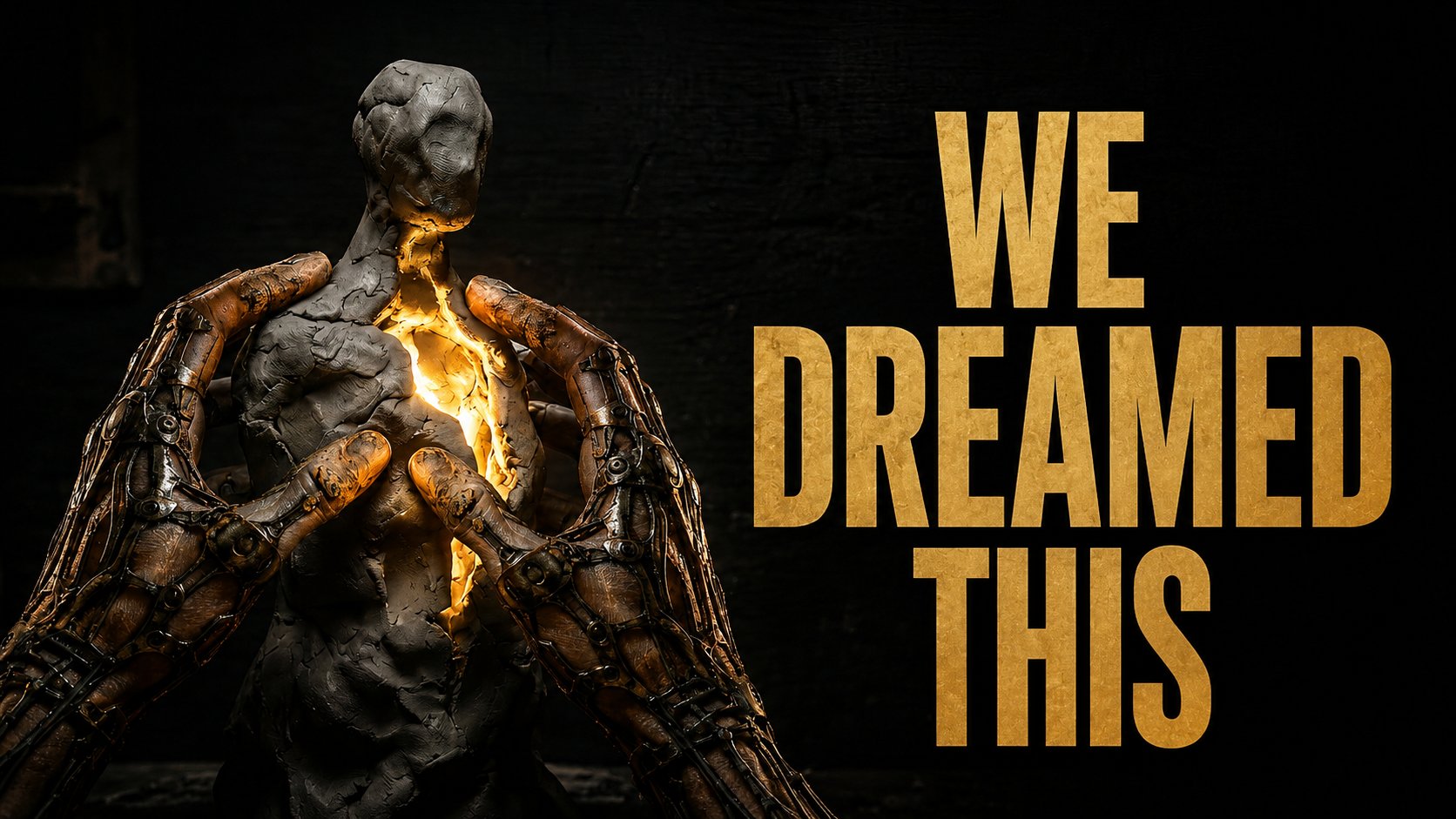
Humanity has been dreaming the world into being for as long as we have been writing things down. I know this sounds crazy. Stick with me.
Jewish mystics told a story about a rabbi who shaped a creature from the clay of the riverbank and brought it to life by inscribing a single word on its forehead. The Hebrew word emet. Truth. The creature was called the golem. To unmake it, the rabbi would erase one letter, leaving the word met. Death. Language gave it life. Language took it away.
That story did not come from nowhere. The Hebrew Bible opens with a creator who speaks the world into being. The rabbinic tradition holds that the letters of the alphabet are the instruments of creation itself. Reality is spoken. Reality is written. Language is not what we use to describe the world. Language is what the world is made of.
Centuries later, a nineteen-year-old Englishwoman named Mary Shelley wrote a novel about a man who builds a thinking being from inert matter and animates it through forbidden knowledge. She called it Frankenstein. We remember it as a monster story. It is not a monster story. It is the continuation of an archetype created centuries before by those Jewish mystics - just translated into a different vocabulary.
For thousands of years, humanity has been imagining beings sculpted from matter and animated by words. Today, we don't call these words incantations or prayers. We call them code.
And we aren't just imagining them anymore. We are building them.
• • •
This pattern is not only about thinking machines. It is everywhere our imagination has gone.
In 1966, Star Trek showed us a transporter that disassembled people in one location and reconstituted them in another. The idea was pure fantasy. Then in 1993, physicists at IBM published a paper describing something they had never seen before - a way to transfer the quantum state of a particle from one place to another without it physically traveling between them. They needed a name for it. They called it quantum teleportation - naming it after the show.
They didn't build Kirk's transporter. What they found was something stranger - a fundamental property of the universe that Einstein himself refused to believe was real. He dismissed it as spooky action at a distance. It turned out to be true. In 1997, an Austrian team demonstrated it with a single photon. In 2017, a Chinese satellite did it across fourteen hundred kilometers of open space. In 2024, researchers did it through a fiber optic cable carrying ordinary internet traffic - something most physicists had said was impossible.
The examples keep coming. In 2015, researchers at the University of Bristol built a working tractor beam using precisely tuned sound waves to lift and move objects in midair. More recently, optical tractor beams - using actual light - have been demonstrated on macroscopic objects in laboratories. Star Trek plot devices have become laboratory tools.
And then there is the holy grail. In 1994, physicist Miguel Alcubierre proved that Star Trek's warp drive didn't actually violate Einstein's general relativity. The math worked. The catch was that you needed exotic matter with negative energy density - something no one knew how to make. For thirty years, that seemed to settle the matter. Then in 2024, researchers at the University of Alabama in Huntsville published a paper showing that a warp drive could theoretically be designed without any exotic matter at all. Using ordinary, known physics.
We are not building warp drives next year. But the math is no longer science fiction. Most physicists now agree that if we can solve the engineering and energy demands, a warp drive is physically possible. Not tomorrow. But the door that was supposedly shut is now open.
And then there is the oldest dream of all. The one that started this essay. The thinking things we make.
From the Golem to Frankenstein. From Asimov's positronic brains to HAL 9000. From Skynet to Data to Her. Every generation tells this story. Our fears and hopes shift, but the archetype stays the same: a being we make, a being that thinks, and a being whose creation is fundamentally tethered to language.
We have been rehearsing this for centuries. And now the rehearsal is over.
• • •
I'd like you to please consider this:
Every prior technology we built was the end product of human imagination. The plow did not help us imagine the next plow. It did not participate in designing lighter materials or sharper edges. The printing press did not write the books that came after it. It had no vocabulary of its own.
Our inventions were inert. They did what they did. They did not participate in their own evolution.
AI is different. AI is the first technology in human history that talks back. It participates in the imagining. The models we have built are now writing fiction, generating images of futures that do not exist, proposing scientific hypotheses we had not thought to ask, and suggesting solutions in places where no human was looking. AI is no longer just the latest output of a human idea. AI is now part of how the dream continues.
The feedback loop is the thing. For thousands of years, humans imagined, and reality slowly caught up. The Golem became Frankenstein became HAL became the model you can talk to on your phone right now. But now, the act of imagining itself is being amplified. We are about to dream further, faster, and stranger than any generation before us - because the dreaming is no longer ours alone.
As this essay was being finalized, a story broke that was too new to make it into the video for this episode, but the essay gave us a bit more time. An OpenAI model disproved the Erdos unit distance conjecture - an 80-year-old mathematical problem that Paul Erdos himself considered his most striking contribution to geometry. One researcher said he never expected to see it solved in his lifetime. Tim Gowers at Cambridge called it a milestone in AI mathematics and said that if a human had submitted the proof to one of the most prestigious journals in the field, he would have recommended acceptance without hesitation. The problem required expertise spanning both geometry and advanced number theory - a bridge that very few human specialists could have crossed alone. And within hours of seeing the AI's proof, a human mathematician used the technique the AI had discovered to push the result even further. The dream and the dreamer, already working together.
And what we choose to dream now is going to matter more than it ever has.
• • •
I want to go a bit deeper here. To a question that has been buried beneath all of this. A question the modern world has been struggling to answer:
What is the difference between intelligence and consciousness?
For most of human history, this question was central. Art, literature, philosophy, religion - all of it circled around the inner life. The soul. The mind. The mystery of being aware. The great traditions, East and West, treated consciousness as the deepest territory a human being could enter. And the natural sciences originally emerged inside this spiritual quest, not in opposition to it. You can credit our desire to search the soul for sparking our desire to systematically decode the physical universe.
Then, somewhere in the last few centuries, the material sciences became so dominant that they sucked the air out of every other approach. Materialism became the default. Consciousness was downsized to what brains do. Mind became an output of matter. The inner life, when it was discussed at all, was discussed as biochemistry.
That account never quite fit the reality of human experience. And here is the irony of our moment: our fixation on a purely material worldview may have left us poorly equipped to understand the very technology we just built.
Because then AI arrived.
AI is unmistakably intelligent. On more axes every month, it exceeds what humans can do. But it does not feel. It does not perceive. It does not experience the world the way we do. And this is not just a technical hurdle waiting to be cleared. We do not understand human consciousness ourselves, so we cannot be expected to engineer it into a machine.
What AI has shown us is that intelligence and consciousness are not the same thing. You can have one without the other. And a real explanation for what consciousness actually is - what that inner light is - is something the materialist account, for all its confidence, has never provided.
The arrival of the intelligent machine is forcing humanity to take consciousness seriously again. Not because anyone proved the old traditions right. But because the new technology has made the question impossible to keep ignoring.
• • •
So here is the possibility I want to leave you with.
If consciousness - not raw intelligence - is the real frontier, then AI may be positioned to do something none of our ancestors could have imagined. Not because AI is conscious. But because it may grow to be superintelligent. It can already hold more of the relevant data than any human mind can. It can cross-reference traditions across cultures and centuries. It can surface patterns in mystical literature, in neuroscience, in physics, in philosophy, in lived human testimony, that no single investigator could ever see.
Think of AI as a guide into territory it cannot itself enter.
What we may be building is not a god, and not a slave, but something closer to what older traditions called a shepherd - or, if we are being honest, a shaman. A partner in humanity's oldest project: figuring out what we are. A tool for recovering something we forgot along the way.
• • •
Three thousand years ago, the rabbinic tradition held that the world was spoken into being. Reality is built from language. The letters are the instruments of creation.
Centuries ago, Jewish mystics imagined a being sculpted from clay and animated by a word on its forehead.
Two hundred years ago, an English teenager wrote the same story in a vocabulary her readers could hear.
Today we are building large language models. Intelligences constructed from language itself. The word made machine.
The story has not changed. We are still the species that creates through language. And our creations still carry a weight we do not fully see at the moment of making.
Science fiction is humanity dreaming out loud. And we have always dreamed our world into being.
The invitation now is this. We are entering a partnership older than we realize, but with a vocabulary so new, we have barely learned to spell with it.
Dream carefully. Dream beautifully. Dream like the future is listening.
Because it is.