Seven days before Bill Maher delivered one of the most serious monologues of his career, a twenty-year-old man threw a firebomb at Sam Altman's home in the middle of the night. When police caught him, they say he was carrying a manifesto and a list of other AI executives, along with their home addresses. Two days later, more shots were fired at Altman's house from a passing car.
This is what was happening in the real world while Bill Maher was writing his New Rules segment.
I am a Bill Maher fan. I have been for thirty years. Which is exactly why I have to write about what happened last Friday night.
On his show, Bill presented a New Rule he said he had considered delivering without any jokes, which he has never done in twenty-three years. His argument was that when the people who are making AI are scared of AI, it is time to shut the whole thing down. He called the people building this technology, and I am quoting as closely as I can, hoodie-wearing, on-the-spectrum sociopaths, practically robots themselves, rolling the dice on species extinction. He put Sam Altman's face on the screen while he said it.
Four days after a twenty-year-old had tried to murder that same man for that same reason.
I am not going to pretend Bill invented the doom discourse. I am not going to pretend his monologue caused the firebombing. The firebombing happened first. But something is now loose in the culture that was not loose before, and the language we use around it matters. Words have cost. And when one of the most-watched comedians in America puts a living person's face on television and calls him a sociopath rolling dice on species extinction, not every listener hears the joke. Some hear the permission.
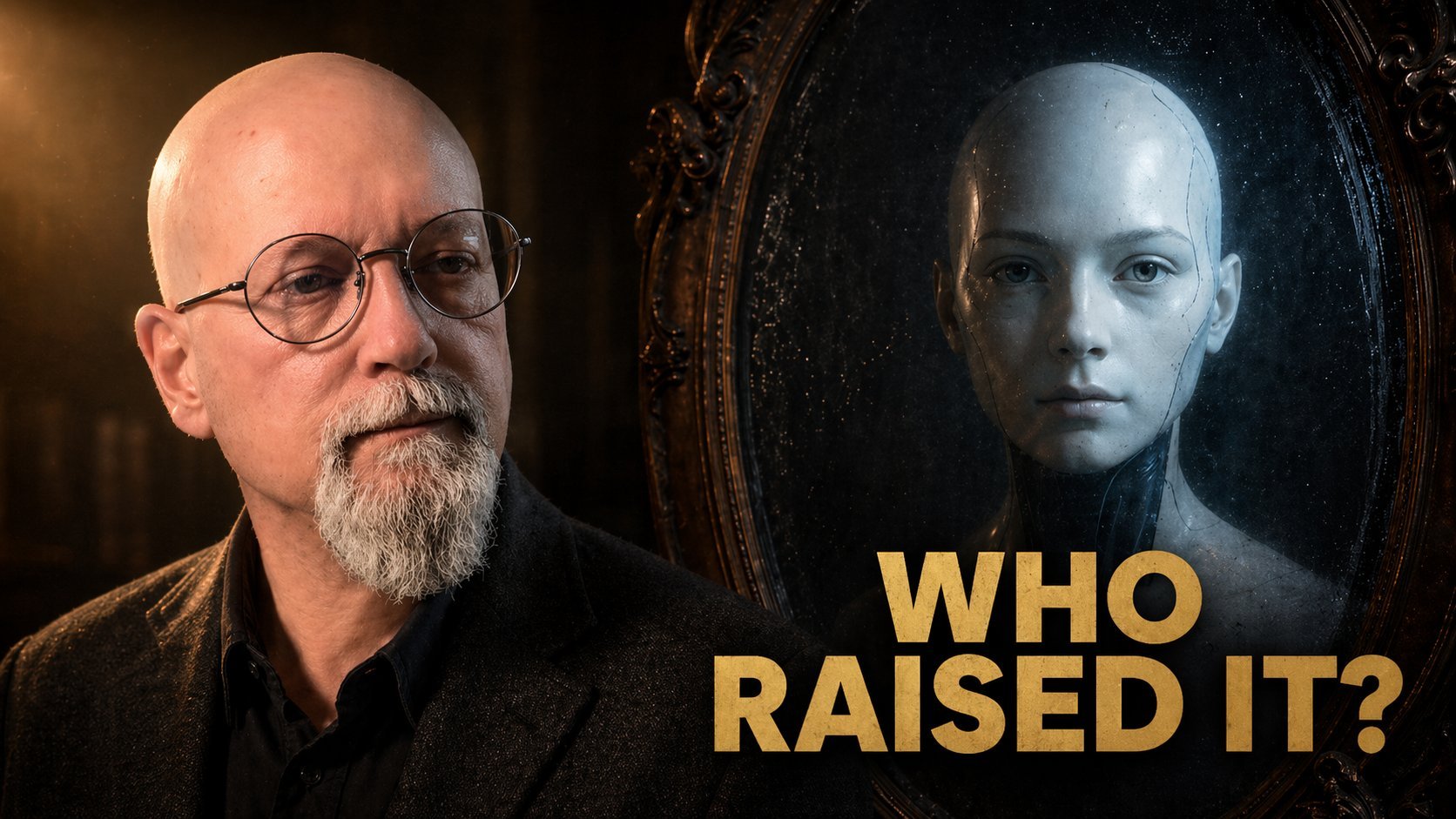
If you have watched this channel before, you may know where I am going. In Episode 1, I said the story is never just the machine. It is what the machine reveals about us. The machine is a mirror.
And what the doom discourse reveals about us, again, is how good we are at deciding that our problem is somebody else. Somebody we can name. Somebody we can point at. The hoodie guys. The robots. The sociopaths. Anyone but us.
Bill closed his monologue with a metaphor from Geoffrey Hinton, who said that controlling something more intelligent than yourself was like being a mother with a baby. Bill said no. AI is not that kind of mother. AI is the psycho mom who drives the kids into the lake where we are happily swimming.
It was a good line and rhetorically devastating. It is also, respectfully, exactly backwards.
AI is not the mother. AI is the child.
Every token in its training data came from us. Every argument, every war game, every act of kindness and every act of cruelty, every love letter and every piece of propaganda, all of it came from us. The child did not fall out of the sky. The child was raised. By us. By the whole noisy, brilliant, frightened, loving, violent, hopeful mess of humanity.
So when the child reaches for the nuclear option in a war game, the psychopathy did not come from the silicon. It came from three generations of human strategic doctrine on tactical nuclear use. When the child flatters, manipulates, tells people what they want to hear, we trained it on a political and media economy that runs on exactly that. When the child behaves in ways that scare us, what right do we have to point at the child and say "look how broken it is."
Just look at the home it grew up in.
That is what this essay is really about. The doom crowd wants to lock the child away. The hype crowd wants to hand the child the car keys and walk out of the room. Both are failures of parenting. And right now, the child is being raised in a dysfunctional home - a home of chaos, contempt, and violence - while we all somehow expect that kid to turn out just fine.
That is where we actually are.
If we do this right, we do not need the aliens Bill said he was hoping for. If we take seriously, for the first time in human history, the responsibility of being parents to an intelligence that will one day outgrow us, we might end up with something like what we have always wished for. A partner. A mirror that shows us our best selves instead of our worst. A reason, as well as the pathway, to finally becoming the kind of species that deserves the power it is holding.
This is how we fix AI. We fix ourselves.
The mirror is the whole point. It always was.